
February 26, 2026 - Proposed Rule Change Regarding Continuing Education Duration Requirements
Click here to view
January 14, 2026 - We are accepting THREE Board Appointment Nominations!
Yes, it is early in the year, but the Annual Alabama APTA Conference is in April this year. This is the Board meeting during which nominations are taken and voted on. The top five nominees for each position will be submitted to the Governor for appointment consideration.
1. The Board is accepting nominations for licensed physical therapists who reside in Congressional Districts 3, 4, 6, or 7. This position is currently held by Dana Daniel Blake from District 6.
To confirm your Congressional District, please go to https://2023-court-ordered-congressional-plan-algeohub.hub.arcgis.com/ and enter your address.
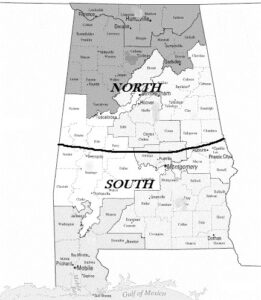
2. The Board is accepting nominations for a licensed physical therapist assistant who resides in the southern division of the state (see map below). This position is currently held by T-Michael Dougherty.
3. The Board is accepting nominations for a consumer member from the state at large. This nominee can reside in any Congressional District of the State. This position is currently held by Margaret Hemm, who has served the maximum number of consecutive terms allowed.
To nominate someone (or yourself!), submit the following:
- A written, signed consent-to-serve letter
- Curriculum vitae
- Short bio
Nominations must be received by March 31, 2026, via mail or email:
Alabama Board of Physical Therapy
100 N. Union Street, Suite 724
Montgomery, AL 36130
info@pt.alabama.gov
New Software Alert!
Renewals start July 1, 2026, and we are pleased to share our new software with you! We encourage you to head to our website and locate the Online Licensee Portal to set up your account so that when it is time to renew, you will be ahead of the game!
Have questions? We’re here to help!
info@pt.alabama.gov
(334) 242-4064
The Administrative Code does not elaborate on which treatment techniques are or are not within the individual PTA’s skill set. The Administrative Code allows for the fact that different clinicians have varying levels of training and skill above entry-level. To that end, the Administrative Code places responsibility on the directing physical therapist (PT) to determine what treatment is appropriate to delegate to a PTA. However, a PTA is also responsible for refusing to carry out treatment they believe is not in the patient’s best interests.
Under Roles and Responsibilities of a Physical Therapist, Section 700-X-3-.03(3)(a) of the Administrative Code states in pertinent part:
[t]he roles and responsibilities of a person licensed by this Board to practice physical therapy in the State of Alabama generally are… 6. [t]o select and delegate the appropriate portions of the treatment plan and program..7…. [t]o delegate only those patient care duties to supportive personnel who are qualified under the provisions of these rules to perform such duties.
Furthermore, Section 700-X-3-.02(2), “Unbecoming Conduct/Conduct Detrimental To The Best Interest Of The Public Prohibited”, includes, “[c]ertain Conduct Specifically Prohibited…(k) [d]elegating responsibilities to a person when the licensee delegating such responsibilities knows or has reason to know that such person is not qualified by education, by experience, or by licensure to perform them.”
[t]he roles and responsibilities of a person licensed by this Board to practice as a physical therapist assistant in the State of Alabama generally are…1. [t]o practice only under the direction of a physical therapist licensed to practice in the State of Alabama…3. [t]o perform treatment procedures as delegated by the physical therapist but not to initiate or alter a treatment plan…7. [t]o refuse to carry out treatment procedures that they believe to be not in the best interest of the patient.